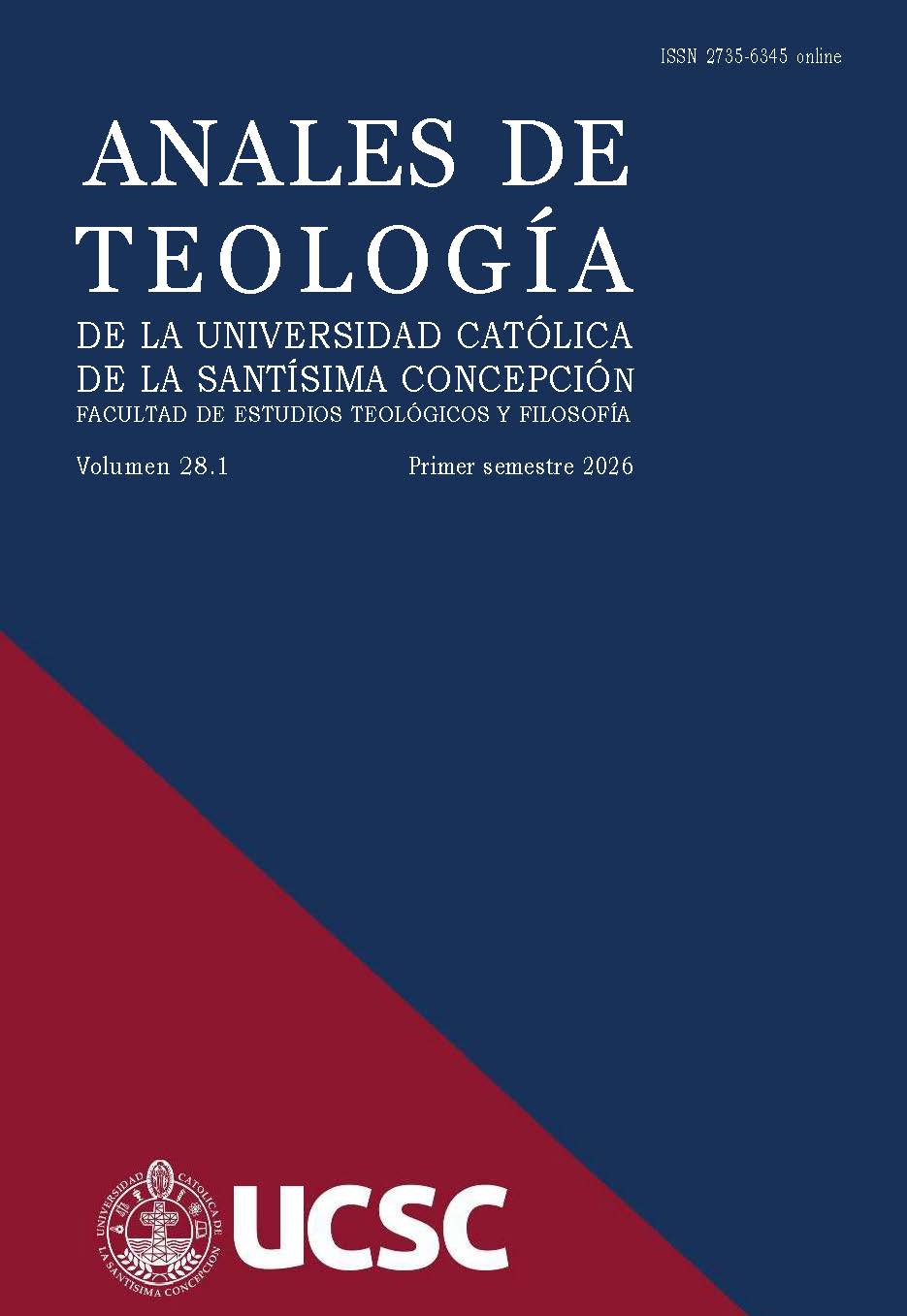
¿Posibilidad de autosalvación? Crisis de la soteriología cristiana ante la inteligencia artificial y el proyecto transhumanista
DOI:
https://doi.org/10.21703/2735-6345.3444Palabras clave:
vulnerabilidad, transhumanismo, inteligencia artificial, salvación, sufrimientoResumen
El artículo examina la crisis soteriológica contemporánea a la luz de la inteligencia artificial (IA) y del transhumanismo, y delimita un marco teológico de respuesta. Se contraste la salvación cristiana –anclada en la gracia y en la transformación del sufrimiento– con proyectos de autosalvación tecnológicos que buscan neutralizar la vulnerabilidad mediante estrategias de antienvejecimiento, trasferencia de la mente (en adelante uploading) y aspiraciones de invulnerabilidad corporal. Tales propuestas reconfiguran el imaginario antropológico y suscitan preguntas decisivas sobre identidad y destino humanos, empujando a la teología a revisar lenguaje y categorías. El trabajo sostiene que la mitigación del dolor y la optimización de la vida constituyen logros apreciables, pero pueden derivar en una reducción técnico-funcional de la persona, ajena a su espesor relacional, comunitario y espiritual. En este horizonte se propone una soteriología actualizada que conserve la centralidad de la redención y, a la vez dialogue críticamente con los aportes de la ciencia y la tecnología, discerniendo sus límites y posibilidades. Así, la salvación se repiensa no como autosuficiencia tecnológica, sino como apertura a la trascendencia que orienta el sentido último de la existencia, sin renunciar a los bienes penúltimos que la técnica puede ofrecer al cuidado y la justicia.
Descargas
Referencias
ARANA, J., “Desafíos antropológicos del transhumanismo”, Pensamiento. Revista de Investigación e Información Filosófica 78.298 (2022) 485-501, https://doi.org/10.14422/pen.v78.i298.y2022.010
BENANTI, P., Vivere il morire: spunti per l’antropologia biomedica, Cittadella, Assisi 2009.
BIBLIA DE JERUSALÉN, Desclée de Brouwer, Bilbao 2019.
BORNAPÉ, A., “‘Solo soy polvo y cenizas’: una mirada al problema del sufrimiento en el libro de Job desde la antropología y la poética hebreas”, DavarLogos XV.1 (2016) 5-21.
BOSTROM, N., “A History of Transhumanist Thought”, Journal of Evolution and Technology 14.1 (2005) 1-25, http://jetpress.org/volume14/freitas.html Citado 20 de agosto de 2025.
BOSTROM, N., “In Defense of Posthuman Dignity”, Bioethics 19.3 (2005) 202-214, https://doi.org/10.1111/j.1467-8519.2005.00437.x
BOSTROM, N., “The Fable of the Dragon Tyrant”, Journal of Medical Ethics 31.5 (2005) 273-277, https://doi.org/10.1136/jme.2004.009035
BOSTROM, N., The Transhumanist FAQ. A General Introduction, Oxford University Press, Oxford 2003.
CABIEDAS, J. M., “Pensar la pregunta del hombre por su salvación en perspectiva teológica. A propósito de la narrativa transhumanista sobre el futuro humano”, Teología y Vida 63.2 (2022) 243-271, https://doi.org/10.7764/TyV/632/4/243-271
COECKELBERGH, M., “Vulnerable Cyborgs: Learning to Live with Our Dragons”, Journal of Evolution and Technology 22.1 (2011) 1-9.
CONCILIO VATICANO II, Constitución dogmática Lumen Gentium, Roma 1964.
CONCILIO VATICANO II. Constitución pastoral Gaudium et spes, Roma 1965.
CONGREGACIÓN PARA LA DOCTRINA DE LA FE, Antiqua et Nova. Nota sobre la relación entre la inteligencia artificial y la inteligencia humana, Roma 2025, https://www.vatican.va/roman_curia/congregations/cfaith/documents/rc_ddf_doc_20250128_antiqua-et-nova_sp.html Citado 20 de agosto 2025.
CORDOVILLA PÉREZ, Á., Teología de la salvación, Sígueme, Salamanca 2021.
CORTINA, A., “Los desafíos éticos del transhumanismo”, Pensamiento. Revista de Investigación e Información Filosófica 78.298 (2022) 471-483, https://doi.org/10.14422/pen.v78.i298.y2022.009
CROTTI, M., La ferita di Medusa: riflessione pedagogica sulla vulnerabilità umana e sociale, Vita e Pensiero, Milano 2009.
DE GREY, A. D. N. J. – RAE, M., Ending Aging: The Rejuvenation Breakthroughs That Could Reverse Human Aging in Our Lifetime, St. Martin’s Press, New York 2007.
DELIO, I., “Artificial intelligence and Christian salvation: Compatibility or competition?”, New Theology Review (2003) 39-50.
DELIO, I., “Suffering and Sacrifice in an Unfinished Universe: The Energy of Love”, Religions 11.7 (2020) 335-346, https://doi.org/10.3390/rel11070335
DELIO, I., The unbearable Wholeness of Being: God, Evolution and the Power of Love, Orbis Books, Maryknoll 2013.
DIÉGUEZ LUCENA, A. J., Transhumanismo: la búsqueda tecnológica del mejoramiento humano, Herder, Barcelona 2017.
DONAHUE, J. R., “‘The “Parable’ of the Sheep and the Goats: A Challenge to Christian Ethics”, Theological studies 47 (1986) 3-31, https://doi.org/10.1177/004056398604700101.
FASOLI, A., “Vulnerability, Embodiment and Emerging Technologies: A Still Open Issue”, Philosophies 8.6 (2023) 115-125, https://doi.org/10.3390/philosophies8060115
FUKUYAMA, F., Our Posthuman Future: Consequences of the Biotechnological Revolution, Farrar, Straus and Giroux, New York 2003.
GÉNOVA, F. J., “Anne Foerst. El encuentro entre teología e inteligencia artificial”, Salmanticensis 64.3 (2017) 313-338, https://doi.org/10.36576/summa.48550.
GRESHAKE, G., ¿Por qué el Dios del amor permite que suframos? Breve ensayo sobre el dolor, Sígueme, Salamanca 2014.
GUDANIEC, A., “Personal Experience of Suffering: Reflections Inspired by Elements of Karol Wojtyła’s Philosophical Anthropology”, Scientia et Fides 12.1 (2023) 215-229, https://doi.org/10.12775/SetF.2024.001
HAUSKELLER, M., “Ephemeroi—Human Vulnerability, Transhumanism, and the Meaning of Life”, Scientia et Fides 7.2 (2019) 9-21, https://doi.org/10.12775/SetF.2019.013
HUBERMAN, J., “Immortality Transformed: Mind Cloning, Transhumanism and the Quest for Digital Immortality”, Mortality 23.1 (2017) 50-64, https://doi.org/10.1080/13576275.2017.1304366
JACKELÉN, A., “The Image of God as Techno Sapiens”, Zygon 37 (2001) 289-301, https://doi.org/10.1111/0591-2385.00429
JUAN PABLO II, Salvifici Doloris. Sobre el sentido cristiano del sufrimiento humano, Vaticano, Roma 1984, https://www.vatican.va/content/john-paul-ii/es/apost_letters/1984/documents/hf_jp-ii_apl_11021984_salvifici-doloris.html Citado 20 de agosto de 2025.
JUNG, D., “Transhumanism and Theological Anthropology: A Theological Examination of Transhumanism”, Neue Zeitschrift für Systematische Theologie und Religionsphilosophie 64.2 (2022) 172-194, https://doi.org/10.1515/nzsth-2022-0009
JUSTO DOMÍNGUEZ, E. J., “Pensar y decir la salvación cristiana”, Estudios Eclesiásticos. Revista de investigación e información teológica y canónica 97.381–382 (2022) 745-771, https://doi.org/10.14422/ee.v97.i381-382.y2022.015
JUSTO DOMÍNGUEZ, E. J., “Vida inmortal y eternidad. Sobre el proyecto transhumanista de inmortalidad”, Scientia et Fides 7.2 (2019) 233-246, https://doi.org/10.12775/SetF.2019.025
JUSTO DOMÍNGUEZ, E. J., La salvación. Esbozo de soteriología, Sígueme, Salamanca 2017.
KORNU, K., “Transfiguration, Not Transhumanism: Suffering as Human Enhancement”, The Heythrop Journal 63.5 (2022) 926-939, https://doi.org/10.1111/heyj.14129
KULL, A., “Cyborg and Religious? Technonature and Technoculture”, Scientia et Fides 4.1 (2016) 295-311, https://doi.org/10.12775/SetF.2016.016
KURZWEIL, R., The Singularity Is Near: When Humans Transcend Biology, Viking, New York 2005.
LEE, N. (ed.), The Transhumanism Handbook, Springer Nature, Cham 2019, 771-776.
LEWIS, C. S., The Abolition of Man, Harper, San Francisco, 1955.
LIEDO FERNANDEZ, B. – RUEDA, J., “In Defence of Posthuman Vulnerability”, Scientia et Fides 9.1 (2021) 215-239, https://doi.org/10.12775/SetF.2021.008
MONTOYA CAMACHO, J. M. – GIMÉNEZ AMAYA, J. M., “El deseo contemporáneo de una salvación tecnificada”, Razón y Fe 287.1461 (2023) 69-94, https://doi.org/10.14422/ryf.vol287.i1461.y2023.005
MONTOYA CAMACHO, J. M. – GIMÉNEZ AMAYA, J. M., “The Recovery of the Natural Desire for Salvation: Foundations for a Narrative Dynamic Theodicy Model Based on the Concept of Bodily Vulnerability”, Scientia et Fides 12.1 (2024) 119-141, https://doi.org/10.12775/SetF.2024.007
MONTOYA CAMACHO, J. M. – GIMÉNEZ AMAYA, J. M., Corporalidad, tecnología y deseo de salvación. Apuntes para una antropología de la vulnerabilidad, Dykinson, s/l 2024, https://doi.org/10.14679/2889
MORE, M. – VITA-MORE, N. (eds.), The Transhumanist Reader: Classical and Contemporary Essays on the Science, Technology, and Philosophy of the Human Future, Wiley-Blackwell, Malden 2013, 146-156.
MORE, M., “Transhumanism: A Futurist Philosophy”, 1990, https://ildodopensiero.it/wp-content/uploads/2019/03/max-more-transhumanism-towards-a-futurist-philosophy.pdf
NICCOL, A.(dir.), Gattaca [película], Columbia Pictures, EE. UU. 1997.
OVIEDO, L., “Evolutionary Explanations of Pain and Suffering: A ‘Gift to Theology’ or a Challenge”, Scientia et Fides 12.1 (2024) 89-105, https://doi.org/10.12775/SetF.2024.005
OVIEDO, L., “La teología ante el transhumanismo”, Pensamiento. Revista de Investigación e Información Filosófica 78.298 (2022) 515-522, https://doi.org/10.14422/pen.v78.i298.y2022.012
PARRA, J. R. L., “Inteligencia artificial: aproximación desde una teología amiga de la ciencia”, Comprendre 23.1 (2021) 49-75.
PFISTER, W. (dir.), Transcendence [película], Alcon Entertainment / Warner Bros., EE. UU. 2014.
PONTIFICIA ACADEMIA DE SANTO TOMÁS DE AQUINO, Il dibattito contemporaneo sulla verità: Atti della II sessione plenaria, 22—24 giugno 2001 = The contemporary debate on the truth, Marietti, Torino 2002, 200-214.
ROJAS MALPICA, C. – ESSER DÍAZ, J. – ROJAS ESSER, M., “Complejidad del dolor y el sufrimiento humano”, Revista Latinoamericana de Psicopatologia Fundamental 7.3 (2004) 70-81, https://doi.org/10.1590/1415-47142004003007
RUINI, C., Chiesa contestata: 10 tesi a sostegno del cattolicesimo, Piemme, Casale Monferrato (Alessandria) 2007.
RUIZ DE LA PEÑA, J. L., Muerte, esperanza y salvación, Fundación Emmanuel Mounier, Madrid 2004.
SEARLE, J. R., “Minds, Brains and Programs”, Behavioral and Brain Sciences 3.3 (1980) 417-457, https://doi.org/10.1017/S0140525X00005756
SPRINGHART, H. – THOMAS, G. (eds.), Exploring Vulnerability, Vandenhoeck & Ruprecht, Göttingen 2017, 13-33.
SPRINGHART, H. – THOMAS, G. (eds.), Exploring Vulnerability, Vandenhoeck & Ruprecht, Göttingen 2017, 35-57.
TILLERÍA AQUEVEQUE, L., “Transhumanismo e inteligencia artificial: el problema de un límite ontológico”, Griot: Revista de Filosofía 22.1 (2022) 59-67, https://doi.org/10.31977/grifi.v22i1.2539.
TORRÓ FERRERO, L. M., “Vulnerabilidad humana en tiempos del poshumano: una reflexión teológica”, Pensamiento. Revista de Investigación e Información Filosófica 73.276 (2017) 767-771, https://doi.org/10.14422/pen.v73.i276.y2017.039
VACCARO, A., “Divinizzazione cristiana e divinizzazione post-umanista”, Vita e Pensiero 2 (2021) 134-137.
VACCARO, A., La linea obliqua: il ruolo della tecnologia nella riflessione teologica, Edizioni Dehoniane Bologna, Bologna 2015.
ZUNA SERRANO, K. (ed.), Transhumanismo y realidades paralelas. Interpelaciones desde la filosofía y la teología, UPS, Quito 2023, 39-54, https://doi.org/10.17163/abyaups.3.
ZUNA SERRANO, K. (ed.), Transhumanismo y realidades paralelas. Interpelaciones desde la filosofía y la teología, UPS, Quito 2023, 109-124, https://doi.org/10.17163/abyaups.3
Descargas
Publicado
Número
Sección
Licencia
Derechos de autor 2026 Jorge Ricardo González López

Esta obra está bajo una licencia internacional Creative Commons Atribución-NoComercial 4.0.
La Anales de Teología es de acceso abierto y no cobra por publicar en ella. Además, regula su política de Derechos de Autor y de acceso a sus archivos de acuerdo con la Licencia Pública Attribution-NonCommercial 4.0 International (CC BY-NC 4.0), por tanto, se permite compartir (reproducir y distribuir el material en cualquier medio o formato) y adaptar (modificar, transformar y crear a partir del material) siempre y cuando se de crédito adecuadamente, se incluya la cita con los datos correspondientes. Además, no está permitido utilizar el material con fines lucrativos.
Cómo citar