Political polarization and natural socialization in computational algorithms
DOI:
https://doi.org/10.21703/issn2735-6337/2025.n47.01Keywords:
echo chambers, filter bubbles, political polarization, Natural Law, natural socializationAbstract
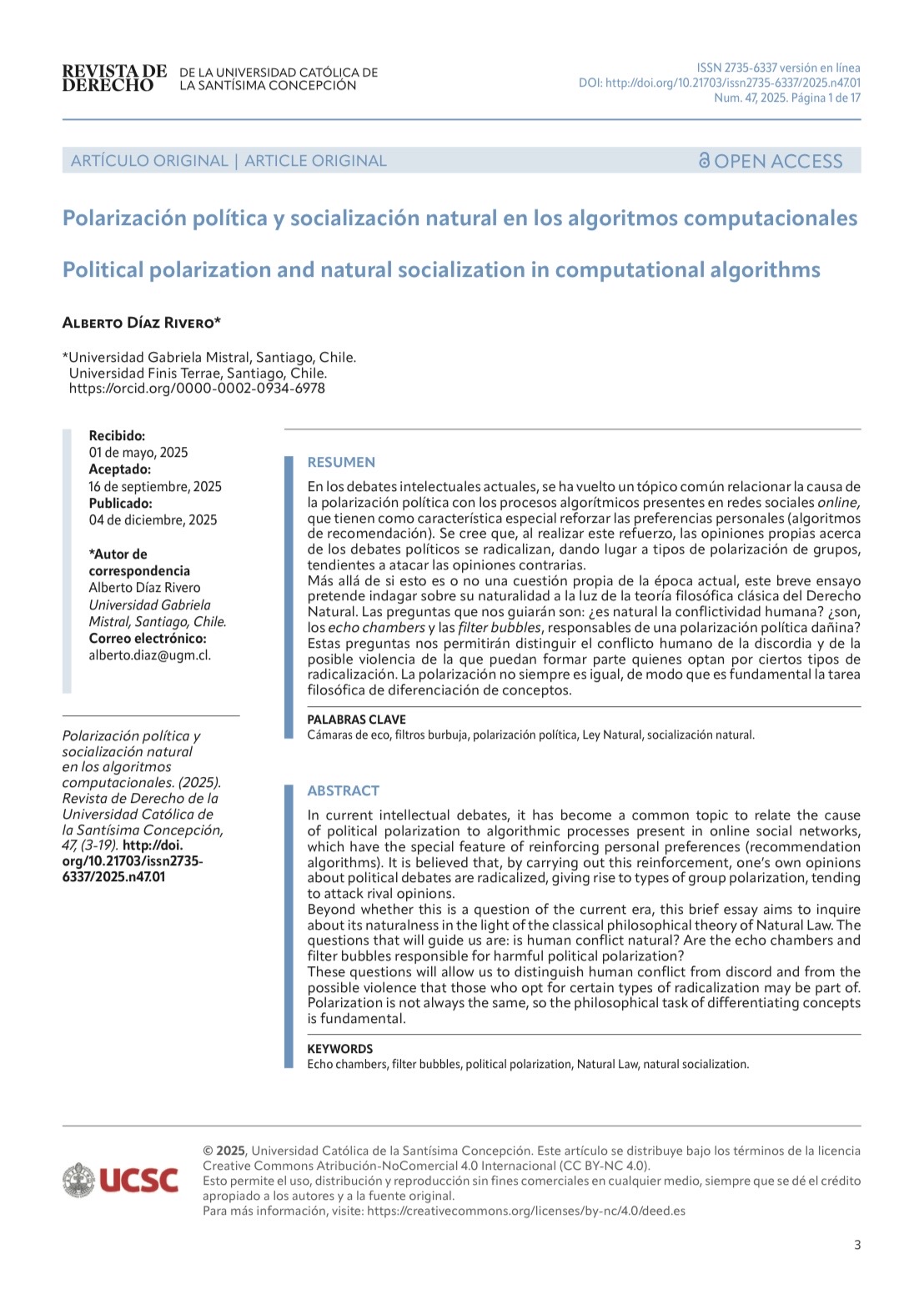
In current intellectual debates, it has become a common topic to relate the cause of political polarization to algorithmic processes present in online social networks, which have the special feature of reinforcing personal preferences (recommendation algorithms). It is believed that, by carrying out this reinforcement, one's own opinions about political debates are radicalized, giving rise to types of group polarization, tending to attack rival opinions.
Beyond whether this is a question of the current era, this brief essay aims to inquire about its naturalness in the light of the classical philosophical theory of Natural Law. The questions that will guide us are: is human conflict natural? Are the echo chambers and filter bubbles responsible for harmful political polarization?
These questions will allow us to distinguish human conflict from discord and from the possible violence that those who opt for certain types of radicalization may be part of. Polarization is not always the same, so the philosophical task of differentiating concepts is fundamental.
Downloads
References
Doctrina citada
AQUINO, Tomás (1786): Tratado del gobierno de los príncipes del Angélico doctor Santo Thomás de Aquino (Madrid, Imprenta de Benito Cano).
AQUINO, Tomás (1952): Suma contra los gentiles (Madrid, Editorial Católica).
AQUINO, Tomás (2016): Cuestiones disputadas sobre la verdad (Pamplona, EUNSA).
ARANGUREN, Javier (2003): Antropología filosófica: una reflexión sobre el carácter excéntrico de lo humano (Madrid, McGraw-Hill).
ARISTÓTELES (1985): Ética nicomáquea (Madrid, Gredos).
ARISTÓTELES (1988): La politica (Madrid, Gredos).
ARISTÓTELES (2009): “Metaphysics”, en: Barnes, Jonathan (editor), The complete works of Aristotle, Bollingen series (Princeton, Princeton University Press).
BAKSHY, Eytan; MESSING, Solomon; y ADAMIC, Lada (2015): “Exposure to ideologically diverse news and opinion on Facebook”, en: Science (vol. 348 núm. 6239). DOI: https://doi.org/10.1126/science.aaa1160
BARRETT, David (2022): “Political Polarization and Social Media”, en: Philosophical Topics (vol. 50 núm. 2). DOI: https://doi.org/10.5840/philtopics202250218
BEARDOW, Jye (2021): “Scroll, Click, Like, Share, Repeat: The Algorithmic Polarisation Phenomenon”, en: ANU Journal of Law and Technology (vol. 2 núm. 1).
BOBBIO, Norberto (1992): Thomas Hobbes (Ciudad de México, Fondo de Cultura Económica).
BOCHEŃSKI, Joseph (2002): Introducción al pensamiento filosófico, 15ª edición (Barcelona, Herder).
CAVIEDES THOMAS, Gabriela (2024): “Absolutos morales en la Teoría Neoclásica de la Ley Natural”, en: Pensamiento. Revista de Investigación e Información Filosófica (vol. 79 núm. 304). DOI: https://doi.org/10.14422/pen.v79.i304.y2023.022
DURRHEIM, Kevin y SCHULD, Maria (2025): “Polarization on social media: Comparing the dynamics of interaction networks and language‐based opinion distributions”, en: Political Psychology (año 2025). DOI: https://doi.org/10.1111/pops.70000
FINKEL, Eli; BAIL, Christopher; CIKARA, Mina; DITTO, Peter; IYENGAR, Shanto; KLAR, Samara; MASON, Lillian; MCGRATH, Mary; NYHAN, Brenda; RAND, David; SKITKA, Linda; TUCKER, Joshua; VAN BAVEL, Jay; WANG, Cynthia y DRUCKMAN, James (2020): “Political sectarianism in America”, en: Science (vol. 370 núm. 6516). DOI: https://doi.org/10.1126/science.abe1715
FULLER, Timothy (2000): “John Locke’s Reflections on Natural Law and the Character of the Modern World”, en: McLean, Edward (editor), Common truths: new perspectives on natural law (Wilmington, ISI Books).
GARCIA, David (2023): “Influence of Facebook algorithms on political polarization tested”, en: Nature (vol. 620 núm. 7972). DOI: https://doi.org/10.1038/d41586-023-02325-x
GARCÍA-HUIDOBRO CORREA, Joaquín (2016): El anillo de Giges: una introducción a la tradición central de la ética, 2ª edición (Santiago, Instituto Res Publica).
GONZÁLEZ JARA, Anselmo (2018): “La posicionalidad excéntrica del hombre. En torno a la antropología de Helmuth Plessner”, en: Anuario Filosófico (vol. 4). DOI: https://doi.org/10.15581/009.4.30486
HERVADA, Javier (1988): Introducción crítica al Derecho natural, 5ª edición (Pamplona, EUNSA).
HILBERT, Martin; AHMED, Saifuddin; CHO, Jaeho; LIU, Billy y LUU, Jonathan (2018): “Communicating with Algorithms: A Transfer Entropy Analysis of Emotions-based Escapes from Online Echo Chambers”, en: Communication Methods and Measures (vol. 12 núm. 4). DOI: https://doi.org/10.1080/19312458.2018.1479843
HOBBES, Thomas (1962): Leviathan (Oxford, Clarendon).
LETELIER WIDOW, Gonzalo (2015): “El bien común político”, en: Miranda, Alejandro y Contreras, Sebastían (editores), Problemas de Derecho Natural (Santiago, Thomson Reuters).
LINDH, Jaime; FÁBREGA, Jorge y GONZÁLEZ, Jorge (2019): “La fragilidad de los consensos. Polarización ideológica en el Chile post Pinochet”, en: Revista de ciencia política (vol. 39 núm. 1). DOI: https://doi.org/10.4067/S0718-090X2019000100099
MACINTYRE, Alasdair (1977): “Epistemological crises, dramatic narrative, and the philosophy of science”, en: Monist (vol. 60 núm. 4). DOI: https://doi.org/10.5840/monist197760427
MACINTYRE, Alasdair (1981): After virtue: a study in moral theory (London, Duckworth).
MACINTYRE, Alasdair (1997): “Politics, philosophy and the Common Good”, en: Knight, Kelvin (editor), The MacIntyre Reader (Notre Dame, Notre Dame University Press).
MACINTYRE, Alasdair (2006): “Toleration and the goods of conflict”, en: MacIntyre, Alasdair (autor), Ethics and Politics: Selected Essays (Cambridge, Cambridge University Press), vol. 2.
MANENT, Pierre (1994): An intellectual history of liberalism, New French thought (Princeton, Princeton University Press). DOI: https://doi.org/10.1515/9780691207193
MANENT, Pierre (2016): Curso de filosofía política (Santiago, Instituto de Estudios de la Sociedad).
MASSINI CORREAS, Carlos (1994): Filosofía del derecho (Buenos Aires, Lexis Nexis), Tomo I: el derecho y los derechos humanos.
MILL, John (1985): On liberty (London, Penguin Books).
NGUYEN, An y VU, Hong (2019): “Testing popular news discourse on the “echo chamber” effect: Does political polarisation occur among those relying on social media as their primary politics news source?”, en: First Monday (vol. 24 núm. 6). DOI: https://doi.org/10.5210/fm.v24i6.9632
PARISER, Eli (2017): El filtro burbuja: cómo la red decide lo que leemos y lo que pensamos (Barcelona, Taurus).
PLESSNER, Helmuth (2022): Los grados de lo orgánico y el hombre: Introducción a la antropología filosófica (Granada, Universidad de Granada).
ROJO-MARTÍNEZ, José Miguel y CRESPO-MARTÍNEZ, Ismael (2023): “Lo político como algo personal: una revisión teórica sobre la polarización afectiva”, en: Revista de ciencia política (vol. 43 núm. 1). DOI: https://doi.org/10.4067/s0718-090x2023005000102
SANTOS ALTAMIRANO, Freddy; VALDEBENITO ALLENDES, Jorge y ORTIZ FUENTES, Jorge (2024): “Jiji, Jaja, Sabotaje y Campaña Sucia: WhatsApp en las Elecciones Presidenciales Chilenas de 2021”, en: Chasqui: Revista Latinoamericana de Comunicación (núm. 156).
SUNSTEIN, Cass (2002): Republic.com, 3ª impresión (Princeton, Princeton University Press).
TUFEKCI, Zeynep (2014a): “Engineering the public: Big data, surveillance and computational politics”, en: First Monday (vol. 19 núm. 7). DOI: https://doi.org/10.5210/fm.v19i7.4901
TUFEKCI, Zeynep (2014): “Facebook and Engineering the Public — Crosspost”, disponible en: https://technosociology.org/?p=1627.
YEPES STORK, Ricardo y ARANGUREN ECHEVERRÍA, Javier (2009): Fundamentos de antropología: un ideal de la excelencia humana, 6a edición, 2a reimpresión (Pamplona, Ediciones Universidad de Navarra).
Jurisprudencia citada
Sob Sigilo con Sob Sigilo (2024): Supremo Tribunal Federal de Brasil, de 02 de septiembre de 2024, PET. 12.404.
Tribunal Constitucional de Rumania (2024): Decisión N°32, de 06 de diciembre de 2024.
Downloads
Published
Issue
Section
License
Copyright (c) 2025 Revista de Derecho de la Universidad Católica de la Santísima Concepción

This work is licensed under a Creative Commons Attribution 4.0 International License.