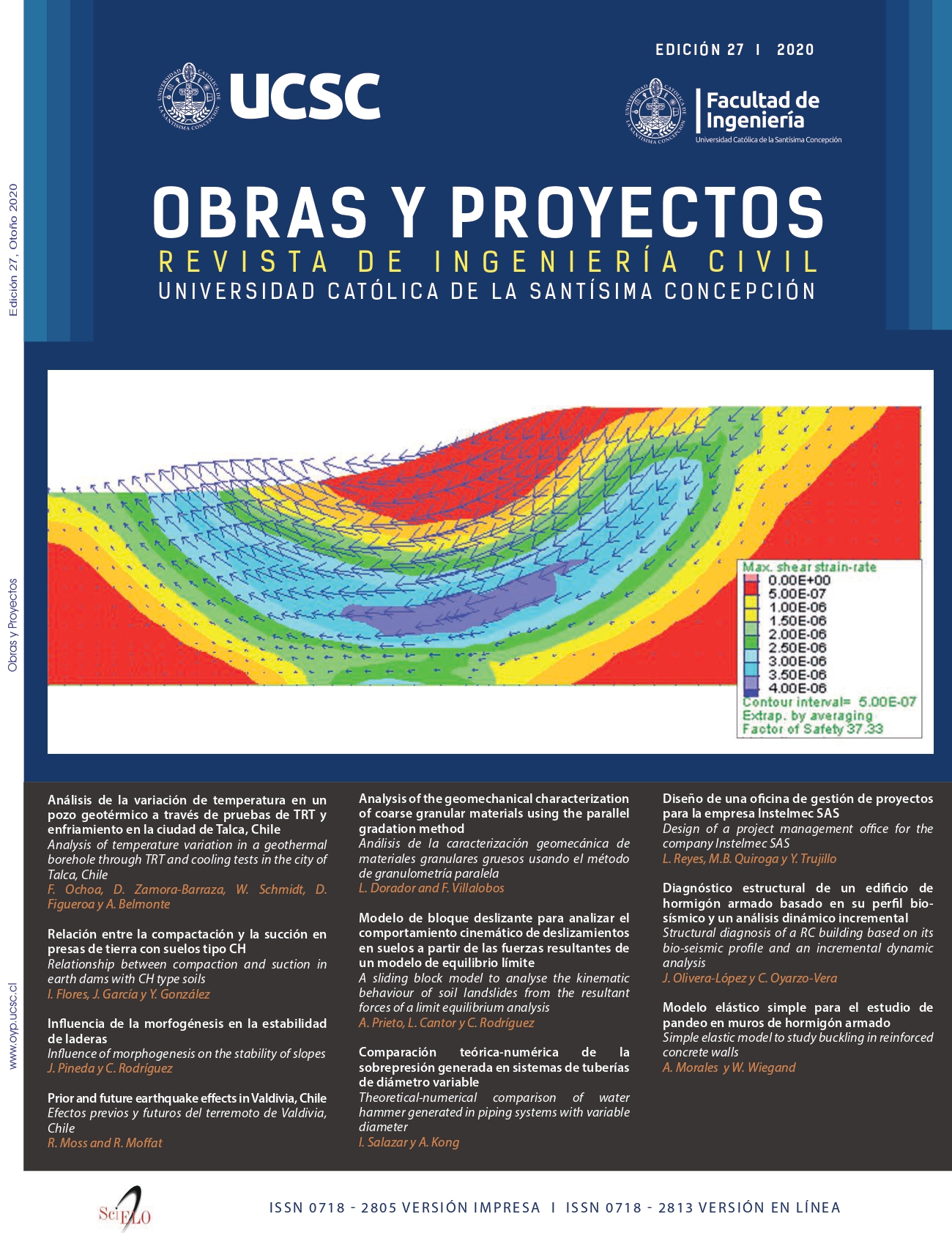
Influencia de la morfogénesis en la estabilidad de laderas
DOI:
https://doi.org/10.4067/S0718-28132020000100026Palabras clave:
Morfogénesis, Procesos geomorfológicos, Esfuerzos, Factor de seguridadResumen
La estabilidad de las laderas es definida por factores intrínsecos (geológicos, geomorfológicos, hidrogeológicos y geotécnicos) y exógenos (lluvias y sismos), que al analizarse y relacionarse correctamente permiten comprender los procesos de inestabilidad y dar soluciones ingenieriles de intervención. Se evalúa la influencia de la morfogénesis, como componente de la geomorfología, en las condiciones de estabilidad mediante modelación numérica, analizando el estado de esfuerzos, el factor de seguridad y los mecanismos de falla para los ambientes estructural, denudaciones y fluvial. Al comparar los resultados con modelos numéricos de laderas en condición geostática se concluye que la magnitud y dirección de los esfuerzos en las laderas depende de los procesos de carga y descarga durante su origen.
Referencias
Abbasi, I.A., Hersi, O.S. and Al-Harthy, A. (2014). Late Cretaceous Conglomerates of the Qahlah Formation, north Oman. In Tectonic Evolution of the Oman Mountains, Rollinson, Searle, Abbasi, Al-Lazki and Al-Kindi (eds.). Geological Society London, UK, Special Publications 392, 325-341.
Barnichon, J.D. (1998). Finite element modelling in structural and petroleum geology. PhD thesis, University of Liege, Belgium.
Buiter, S.J.H., Yu, A., Babeyko, S.E., Gerya, T.V., Kaus, B.J.P., Kellner, A., Schreurs, G. and Yamada, Y. (2006). The numerical sandbox: comparison of model results for a shortening and an extension experiment. In Analogue and Numerical Modelling of Crustal-Scale Processes, Buiter and Scheurs (eds.), Geological Society of London, UK, Special Publication 253, 29-64.
Colletta, B., Letouzey, J., Pinedo, R., Ballard, J.F. and Balé, P. (1991). Computerized X-ray tomography analysis of sandbox models: examples of thin-skinned thrust systems. Geology 19(11), 1063-1067.
Ellis, S., Schreurs, G. and Panien, M. (2004). Comparisons between analogue and numerical models of thrust wedge development. Journal of Structural Geology 26(9), 1659 –1675.
FLAC 2D (2011). FLAC – Fast Lagrangian Analysis of Continua Dynamic Analysis. Itasca Consulting Group Inc., Minneapolis, Minnesota, USA.
Ford, J.T. (2015). Computer models of a basement involved fault propagation fold during the Laramide Orogeny around Las Vegas, New Mexico. MSc thesis, The University of Texas at Arlington, USA.
Han, Y., Cundall, P.A. and Hart, R.D. (2008). Automatic remeshing logic in large strain continuum simulations. In Continuum and Distinct Element Numerical Modeling in GeoEngineering. Hart, Detournay and Cundall (eds.), Itasca Consulting Group Inc. Minneapolis, USA, paper 02-02.
Henk, A. and Nemcok, M. (2008). Stress and fracture prediction in inverted half-graben structures. Journal of Structural Geology 30(1), 81 -97.
Holmes, A. (1965). Principles of physical geology. Nelson, London, UK.
Hutchinson, J.N. (1988). Morphology and geotechnical parameters of landslides in relation to geology and hydrogeology. 5th International Symposium on Landslides, Lausanne, Switzerland, vol. 1, 3-35.
Jaquet, Y., Duretz, T., Grujic, D., Masson, H. and Schmalholz, S.M. (2018). Formation of orogenic wedges and crustal shear zones by thermal softening, associated topographic evolution and application to natural orogens. Tectonophysics 746, 512-529.
Nagel, T.J. and Buck, W.R. (2004). Symmetric alternative to asymmetric rifting models. Geology 32(11), 937-940.
Nemcok, M., Mora, A. and Cosgrove, J. (2013). Thick-skindominated orogens: from initial inversion to full accretion: an introduction. Geological Society of London, UK, Special Publications 377, 1– 17.
Pasupuleti, V.D.K. (2016). Non-linear numerical modelling of tectonic plate for understanding crustal deformation and stress accumulation at plate junctions. PhD thesis, International Institute of Information Technology-Hyderabad, India.
Platt, J.P. (1986). Dynamics of orogenic wedges and the uplift of high-pressure metamorphic rocks. Geological Society of America Bulletin 97(9), 1037–1053.
Ruh, J.B., Kaus, B. J. and Burg, J.P. (2012). Numerical investigation of deformation mechanics in fold-and-thrust belts: Influence of rheology of single and multiple décollements. Tectonics 31(3), TC3005.
Sclater, J.G. and Célérier, B. (1987). Extensional models for the formation of sedimentary basins and continental margins. Norsk Geologisk Tidsskrift 67(4), 253-267.
Sobolev, S.V. and Babeyko, A.Y. (2005). What drives orogeny in the Andes?. Geology 33(8), 617–620.
Sørensen, E.S. (2012). Elasto-plastic hardening Mohr-Coulomb model - Derivation and implementation into the Finite Element Method using principal stress space. Master thesis, Aalborg University, Denmark.
Willett, S., Beaumont, C. and Fullsack, P. (1993). Mechanical model for the tectonics of doubly vergent compressional orogens. Geology 21(4), 371–374.
Yamato, P., Mouthereau, F. and Burov, E. (2009). Taiwan mountain building: insights from 2-D thermomechanical modelling of a rheologically stratified lithosphere. Geophysical Journal International 176(1), 307–326.
Zhang, J. (2014). Numerical modeling of the formation and evolution of basement-involved structures in Wyoming. Doctoral thesis, Rice University, Texas, USA.
Descargas
Publicado
Número
Sección
Licencia

Esta obra está bajo una licencia internacional Creative Commons Atribución-NoComercial 4.0.