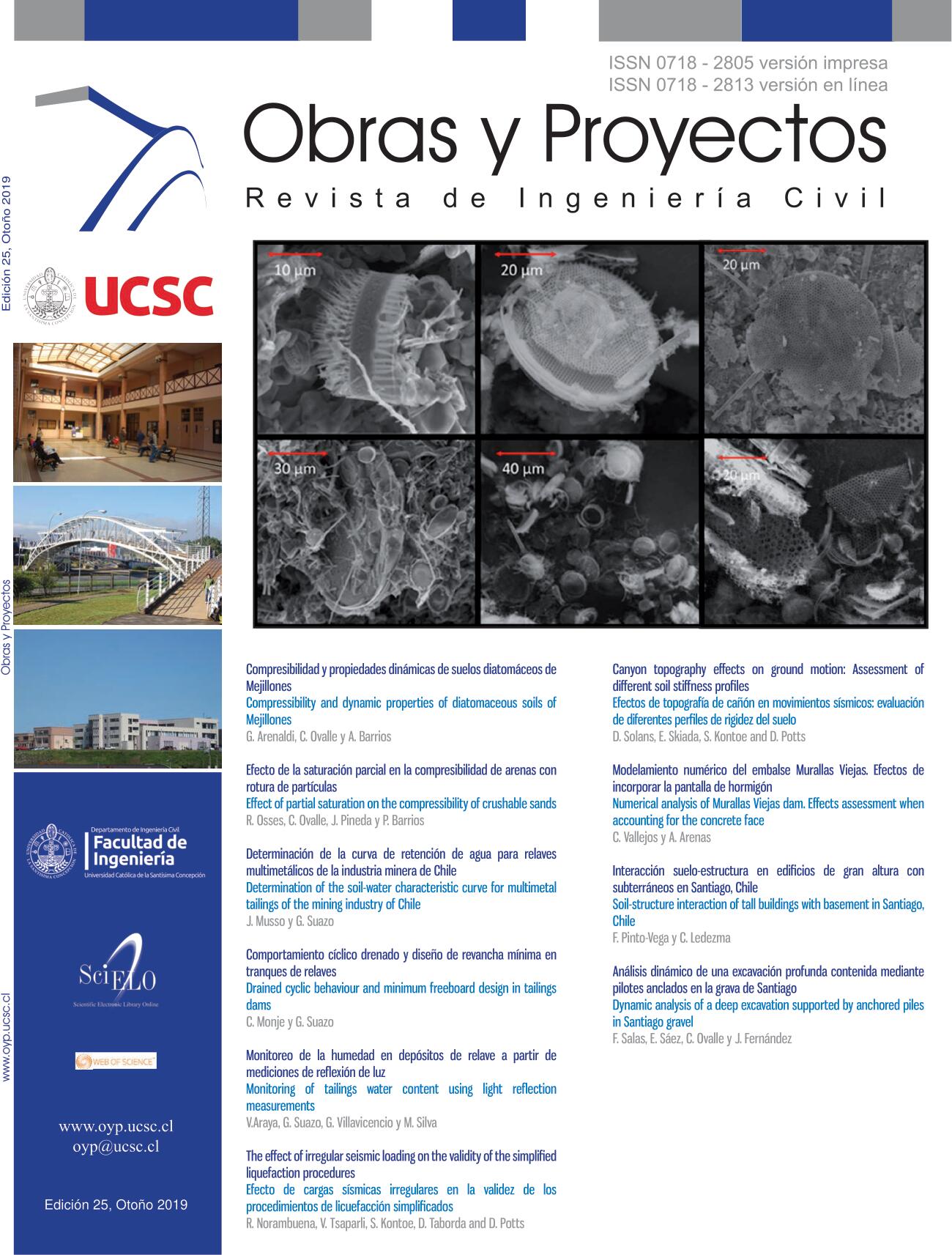
Efecto de cargas sísmicas irregulares en la validez de los procedimientos de licuefacción simplificados
DOI:
https://doi.org/10.4067/S0718-28132019000100042Palabras clave:
Licuefacción, Metodología simplificada, Análisis de elementos finitos, Número equivalente de ciclos, Plasticidad de superficie límiteResumen
Licuefacción sísmica ha sido uno de los mayores peligros para proyectos de ingeniería atribuidos a terremotos. Las metodologías comúnmente utilizadas para evaluar licuefacción siguen basándose en métodos semi-empíricos. El procedimiento simplificado para evaluar el potencial de licuefacción asume que los terremotos pueden ser representados por un número equivalente de ciclos uniformes, proporcionales a la aceleración superficial máxima de un registro. Las principales metodologías para calcular el número equivalente de ciclos están basadas en la regla de daño acumulado de Miner, desarrollada para el análisis de fatiga en metales. La aplicabilidad de este concepto en suelos ha sido ampliamente cuestionada, dado que los suelos tienen un comportamiento no lineal. El presente trabajo investiga numéricamente el concepto de ciclos de amplitud uniforme equivalentes. Se efectúan análisis de esfuerzos no lineales en elementos finitos utilizando un modelo constitutivo de plasticidad de superficie límite que permite simular realísticamente licuefacción, reproduciendo precisamente la resistencia cíclica de las arenas. Bajo un análisis hidro-mecánico acoplado, se estudia un depósito de arenas de 15 m de profundidad sujeto a solicitaciones sísmicas, a fin de establecer una referencia de los alcances de la licuefacción. En paralelo, se desarrollan análisis de respuesta drenados para obtener los registros irregulares de esfuerzo, los cuales son convertidos en registros cíclicos uniformes. Se efectúan simulaciones de ensayos de corte simple no drenado sometidos a los registros uniformes generados. Los resultados de los ensayos de corte simple se comparan con los modelos en términos de licuefacción y se concluye sobre la validez de la metodología de Seed et al. (1975), basada en el concepto de daño acumulado de Miner.
Referencias
ASTM E1049 (2011). Standard practices for cycle counting definitions for fatigue analysis. ASTM International, West Conshohocken, PA, USA.
Azeiteiro, R.N.J., Marques, V.D. and Coelho, P.A.L.F (2012). Effect of singular peaks in uniform cyclic loading on the liquefaction resistance of a sand. 2nd International Conference on Performance-Based Design in Earthquake Geotechnical Engineering, Taormina, Italy.
Bathe, K. (1996). Finite element procedures. New Jersey: Prentince Hall.
Biondi, G., Cascone, E. and Maugeri, M. (2004). Number of uniform stress cycles equivalent to seismic loading. 11th International Conference on Soil Dynamics and Earthquake Engineering and 3rd International Conference on Earthquake Geotechnical Engineering, vol. 2, Berkeley, California, USA, 705-712.
Chung, J. and Hulbert, G.M. (1993). A time integration algorithm for structural dynamics with improved numerical dissipation: The generalized-a method. Journal of Applied Mechanics 60(2), 371-375.
Coelho, P.A.L.F., Azeiteiro, R.J.N., Marques, V.D., Santos, L.M.A. and Taborda, D.M.G. (2013). Challenges to the laboratory evaluation of field liquefaction resistance. 18th International Conference on Soil Mechanics and Geotechnical Engineering, Paris, France, 1459-1462.
Elgamal, A.-W., Zeghal, M., Tang, H.T. and Stepp, J.C. (1995). Lotung downhole array. I: Evaluation of site dynamic properties. Journal of Geotechnical Engineering 121(4), 350–362.
Hancock, J. and Bommer, J. (2005). The effective number of cycles of earthquake ground motions. Earthquake Engineering and Structural Dynamics 34, 637-664.
Hazen, A. (1920). Hydraulic-fill dams. Transactions of the American Society of Civil Engineers 83(1), 1713-1745.
Idriss, I. and Boulanger, R. (2008). Soil liquefaction during earthquakes. Oakland, California: Earthquake Engineering Research Institute.
Miner, M. (1945). Cummulative damage in failure. Journal of Applied Mechanics 12(3), 159-164.
Okada, T., Umino, N. and Hasegawa, A. (2003). Rupture process of the July 2003 northern Miyagi earthquake sequence, NE Japan, estimated from double-difference hypocenter locations. Earth, Planets and Space 55(12), 741–750.
Pan, K. and Yang. Z.X. (2019). Evaluation of the liquefaction potential of sand under random loading conditions: equivalent approach versus energy-based method. Journal of Earthquake Engineering (in press).
Papadimitiou, A.G. and Bouckovalas, G.D. (2002). Pasticity model for sand under small and large cyclic strains; a multiaxial formulation. Soil Dynamics and Earthquake Engineering 127(11), 191-204.
Potts, D.M. and Zdravkovic, L. (1999). Finite element analysis in geotechnical engineering: theory. Thomas Telford, London, UK.
Seed, H.B. and Idriss, I.M. (1971). Simplified procedure for evaluating soil liquefaction potential. Journal of Soil Mechanics and Foundation Division 97(9), 1249-1273.
Seed, H.B., Idriss, I.M., Makdisi, F. and Banerjee, N. (1975). Representation of irregular stress time histories by equivalent uniform stress series in liquefaction analysis. Earthquake Engineering Research Center, Berkeley, California.
Shen, C.K., Harder, A.M., Vrymoed, J.L. and Bennett, W.J. (1978). Dynamic response of a sand under random loadings. ASCE Geotechnical Engineering Division Special Conference on Earthquake Engineering and Soil Dynamics, vol. 2, 852-863.
Taborda, D.M.G. (2011). Development of constitutive models for application in soil dynamics. PhD thesis, Imperial College London, UK.
Taborda, D., Zdravkovic, L., Kontoe, S. and Potts, D. (2014). Computational study on the modification of a bounding surface plasticity model for sands. Computers and Geotechnics 59, 145–160.
Tsai, Y.-B. and Huang, M.-W. (2000). Strong ground motion characteristics of the Chi-Chi, Taiwan, earthquake of September 21, 1999. Earthquake Engineering & Engineering Seismology 2(1), 1–21.
Tsaparli. V. (2017). Numerical modelling of earthquake-induced liquefaction under irregular and multi-directional loading. PhD thesis, Imperial College London, UK.
Tsaparli, V., Kontoe, S., Taborda, D.M.G. and Potts, D.M. (2015). Numerical investigation of the effect of the irregular nature of the seismic loading on the liquefaction resistance of saturated sand deposits. Society for Earthquake and Civil Engineering Dynamics SECED 2015 Conference: Earthquake Risk and Engineering towards a Resilient World, Cambridge, UK.
Tsuchida, H. (1970). Prediction and counter measure against the liquefaction in sand deposits. Abstracts of Seminars in the Ports and Harbour Research Institute, Japan, 3.1-3.33 (in Japanese).
Youd, T.L. and Perkins, D.M. (1978). Mapping liquefactioninduced ground failure potential. Journal of the Geotechnical Engineering Division 104(4), 433-446.
Youd, T.L., Idriss, I.M., Andrus, R.D., Arango, I., Castro, G., Christian, J.T., Dobry, R., Finn, W.D.L., Harder, L.F., Hynes, M.E., Ishihara, K., Koester, J.P., Liao, S.S.C., Marcuson III, W. F., Martin, G.R., Mitchell, J.K., Moriwaki, Y., Power, M. S., Robertson, P. K., Seed, R.B. and Stokoe II, K.H. (2001). Liquefaction resistance of soils: summary report from the 1996 NCEER and 1998 NCEER/NSF Workshops. Journal of Geotechnical and Geoenvironmental Engineering 127(10), 817-833.
Zienkiewicz, O., Bicanic, N. and Shen, F.Q. (1988). Earthquake input definition and the transmitting boundary conditions. In Advances in Computational Nonlinear Mechanics, I.S. Doltnis (ed.), 109–138, Springer.
Descargas
Publicado
Número
Sección
Licencia

Esta obra está bajo una licencia internacional Creative Commons Atribución-NoComercial 4.0.