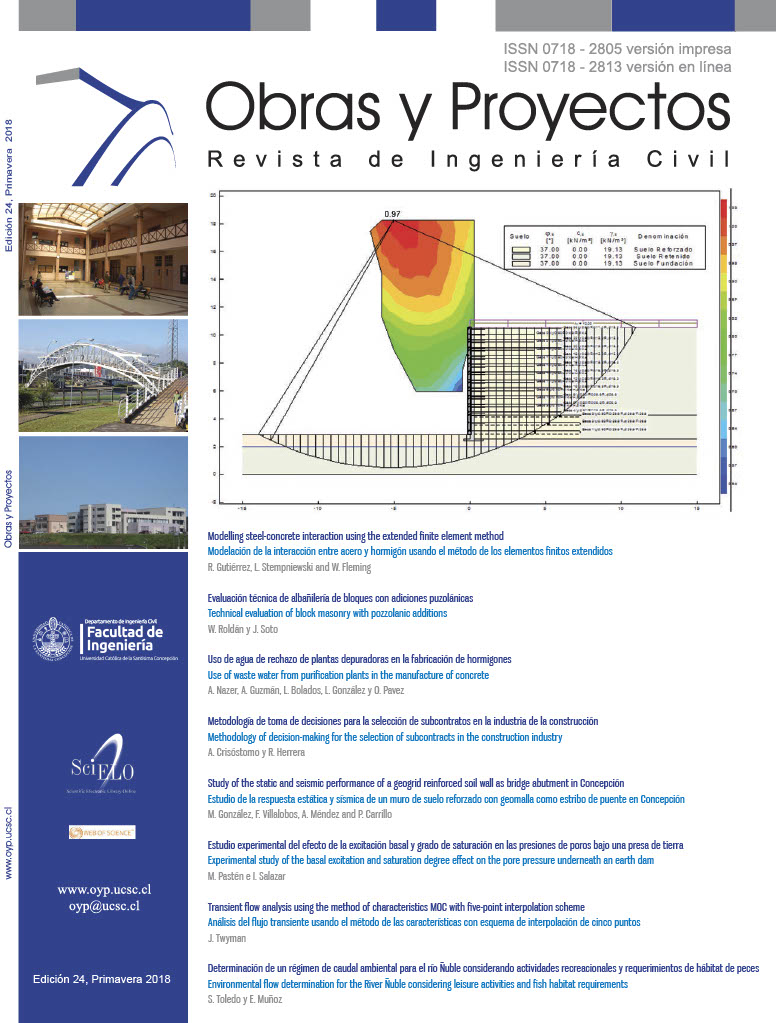
Estudio de la respuesta estática y sísmica de un muro de suelo reforzado con geomalla como estribo de puente en Concepción
DOI:
https://doi.org/10.4067/s0718-28132018000200041%20Palabras clave:
Geomalla, Muro de suelo reforzado, Estabilidad estática y sísmica, Estabilidad interna y externaResumen
El terremoto del 27 de febrero 2010 en Chile central y sur fue una prueba muy intensa para las soluciones con muro de suelo reforzado recientemente construidas como estribos de puente. Este terremoto de subducción de magnitud momento 8.8 causó graves daños a varios muros de hormigón armado tradicionales para estribos de puentes. Sin embargo, no se registró mayor daño en soluciones relativamente nuevas y reforzadas con geosintéticos. Por esta razón, es importante revisar el diseño y construcción empleada en estos proyectos. Para este fin, se describe y estudia un caso representativo ubicado próximo al epicentro. Además, se entrega información sobre los suelos de fundación, diseño y secuencia constructiva de los refuerzos de geosintéticos usados en los estribos de puente. Los suelos de fundación eran desfavorables, correspondiendo principalmente a depósitos fluviales y marinos próximos al cauce y desembocadura del río Andalién. El análisis incluye la verificación de la estabilidad estática y sísmica, tanto externa como interna. También se realizan análisis de estabilidad global estática y sísmica. Los métodos usados en los análisis son equilibrio límite y pseudo estático según las recomendaciones de FHWA. Resultados muestran que el diseño fue adecuado para soportar un evento sísmico tan fuerte en términos de estabilidad interna y externa. No obstante, se encontró que la presencia de pilotes prevenía una falla sísmica global del muro de suelo reforzado con geomallas como estribo de puente. Se realizan comentarios y observaciones finales relacionados con el diseño y construcción que podrían explicar la respuesta favorable de las estructuras reforzadas con geosintéticos sometidas a este fuerte terremoto de subducción.
Referencias
Abu-Hejleh, N., Wang, T. and Zornberg, J.G. (2000). Performance of geosynthetic-reinforced walls supporting bridge and approaching roadway structures. In Advances in Transportation and Geoenvironmental Systems Using Geosynthetics, ASCE, 218-243.
ASTM D6637 (2015). Standard test method for determining tensile properties of geogrids by the single or multi-rib tensile method. West Conshohocken, PA, USA.
Boroschek, R.L., Soto, P. and Leon, R. (2010). Maule Region Earthquake, 27 February 2010, Mw 8.8. National Accelerometer Net renadic.cl, Report 10/08, University of Chile.
BS 8006 (2010). Code of practice for strengthened/reinforced soil and other fills. British Standard Institution, Milton Keynes, UK.
Buckle, I., Hube, M., Chen, G., Yen, W.H. and Arias, J. (2012). Structural performance of bridges in the offshore Maule earthquake of 27 February 2010. Earthquake Spectra 28(1), 533-552.
Das, B.M. (2012). Retaining walls. Handbook of Geosynthetic Engineering. Geosynthetics and their applications. Edited by Shukla, S.K. Second edition. Thomas Telford.
FHWA (2011). Postearthquake reconnaissance report on transportation infrastructure impact of the February 27, 2010, offshore Maule Earthquake in Chile. Federal Highway Administration USA. Publication No. FHWA-HRT-11-030.
FHWA (2009). Design and construction of mechanically stabilized earth walls and reinforced soil slopes. Federal Highway Administration USA. Publication No. FHWA-NHI-10-024.
FHWA (2001). Mechanically stabilized earth walls and reinforced soil slopes design and construction guidelines. Federal Highway Administration USA. Publication No. FHWA-HRT-00-043.
Galindo, A. (2014). Actualidad del diseño de muros de suelo reforzado, análisis comparativo entre FHWA NHI-10-024 (EEUU), BS8006 (Gran Bretaña) y EBGEO 2010 (Alemania). Ingeniería Civil 175, 115-124.
Geo5 (2015). MSE wall. Verification of mechanically stabilized earth walls and segmental retaining walls reinforced by geogrids. Fine civil engineering software. Praha, Czech Republic.
GGU Stability (2015). Slope stability analysis and analysis of soil nailing and reinforced earth walls. GGU GmbH, CivilServe.
González, M.D. (2015). Design and construction of retaining structures reinforced by geogrids for bridge abutments. Civil Engineer degree project, Catholic University of Concepción, Chile (in Spanish).
Helwany, S.M., Wu, J.T. and Froessl, B. (2003). GRS bridge abutments—an effective means to alleviate bridge approach settlement. Geotextiles and Geomembranes 21(3), 177-196.
Hube, M., Santa María, H. and Villalobos, F. (2010). Preliminary analysis of the seismic response of bridges during the Chilean 27 February 2010 earthquake. Obras y Proyectos 8, 48-57.
Jacobs, F., Ruiken, A. and Ziegler, M. (2016). Investigation of kinematic behavior and earth pressure development of geogrid reinforced soil walls. Transportation Geotechnics 8, 57-68.
Koseki, J., Koda, M., Matsuo, S., Takasaki, H. and Fujiwara, T. (2012). Damage to railway earth structures and foundations caused by the 2011 off the Pacific Coast of Tohoku Earthquake. Soils and Foundations 52(5), 872-889.
Ledezma, C., Hutchinson, T., Ashford, S.A., Moss, R., Arduino, P., Bray, J.D., Olson, S., Hashash, Y.M., Verdugo, R., Frost, D. and Kayen, R. (2012). Effects of ground failure on bridges, roads, and railroads. Earthquake Spectra 28(1), 119-143.
Ruiz-Tagle, L. and Villalobos, F. (2011a). Experimental study of the lateral earth pressure on retaining structures in soils reinforced with geogrids. Revista Ingeniería de Construcción 26(3), 299-320.
Ruiz-Tagle, L. and Villalobos, F. (2011b). Estudio experimental y numérico del desplazamiento y rotación de suelo reforzado con geomallas bajo empuje activo. Obras y Proyectos 9, 59-65.
Soubra, A.H. (1999). Upper-bound solutions for bearing capacity of foundations. Journal of Geotechnical and Geoenviromental Engineering 125, No. 1, 59-68.
Tatsuoka, F., Koseki, J., Tateyama, M., Munaf, Y. and Horii, K. (1998). Seismic stability against high seismic loads of geosyntheticreinforced soil retaining structures. 6th International Conference on Geosynthetics, Atlanta, USA, R.K. Rowe ed., vol. 1, 103-142.
Tatsuoka, F., Tateyama, M. and Koseki, J. (1996). Performance of soil retaining walls for railway embankments. Soils and Foundations 36, 311-324.
Verdugo, R., Villalobos, F., Yasuda, S., Konagai, K., Sugano, T., Okamura, M., Tobita, T. and Torres, A. (2010). Description and analysis of geotechnical aspects associated to the large 2010 Chile earthquake. Obras y Proyectos 8, 25-36.
Descargas
Publicado
Versiones
- 2018-12-01 (2)
- 2021-11-25 (1)
Número
Sección
Licencia

Esta obra está bajo una licencia internacional Creative Commons Atribución-NoComercial 4.0.